failed_double_bottom
Failed Double Bottom Breakdown
Bullish reversal: price broke below support (double bottom breakdown) but then rises back above the support level. Bears are trapped. Failure threshold normalized by daily volatility.
Signal family
Pattern — Formal chart-pattern detectors (double tops / bottoms, failed breakouts, HH/HL structure).
Parameters
| Name | Description | Default | Range |
|---|---|---|---|
| peak_order | Peak detection window | 15 | 5–25 |
| tolerance_zscore | Tolerance (z-scores of daily vol) | 1.5 | 0.5–3.0 |
| failure_window | Max days for failure after breakdown | 60 | 20–120 |
Historical context
12,573 valid triggers on 3,054 distinct tickers between 2015-10-07 and 2026-04-21. Universe: us_only · mcap ≥ $100,000,000 · price ≥ $1 (3,055 tickers). Entry at open T+1. 1d = intraday T+1; 20d = open T+1 to close T+20.
Benchmarks: spxew (S&P 500 Equal Weight — the primary benchmark here; a median-stock view that avoids the 2020+ megacap-concentration distortion), spx (S&P 500, cap-weighted), and msci (MSCI World USD). Per-stock regime: trending = ADX(14) ≥ 25, high vol = 20d ann. vol ≥ 20%.
At a glance (20d alpha vs S&P 500 Equal Weight, US-only)
Failed Double Bottom Breakdown is a single-direction signal — only the bullish side is meaningful. (A failed pattern reverses the original setup, so the direction flips by construction.)
Reading this: the random-date null is: for each ticker, sample N random dates and compute the same alpha — what alpha does a signal with no information produce? If the signal's observed alpha beats the null (pperm≤0.05), it's adding real information. If it's inside or worse than the null, the signal doesn't add value over random firing — any observed alpha is either noise or a universe artifact.
How often does FAILED_DOUBLE_BOTTOM fire in each regime?
The signal's bucket distribution is itself informative. If 50%+ of all FAILED_DOUBLE_BOTTOM triggers fire in the "non-trending + high vol" quadrant, the signal is structurally a chop-market event — regardless of what its textbook definition claims. Bullish and bearish are shown separately; counts are across the full US-only sample after the mcap and price floor.
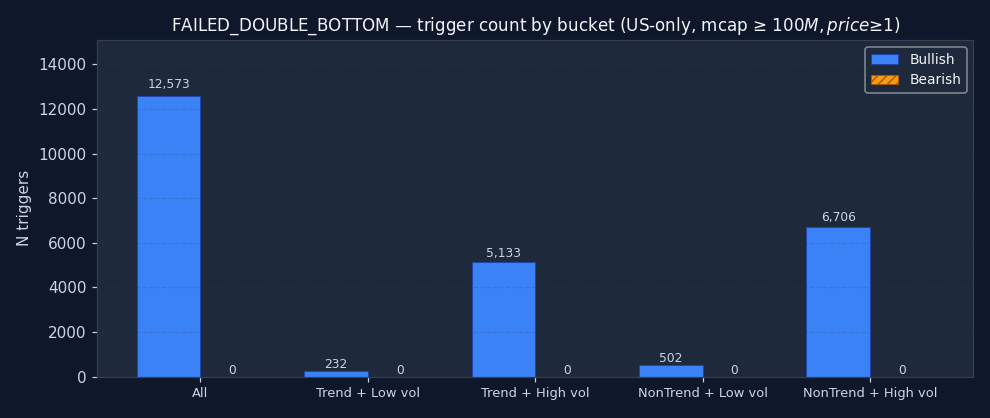
Per-stock regime quadrant — 20d alpha
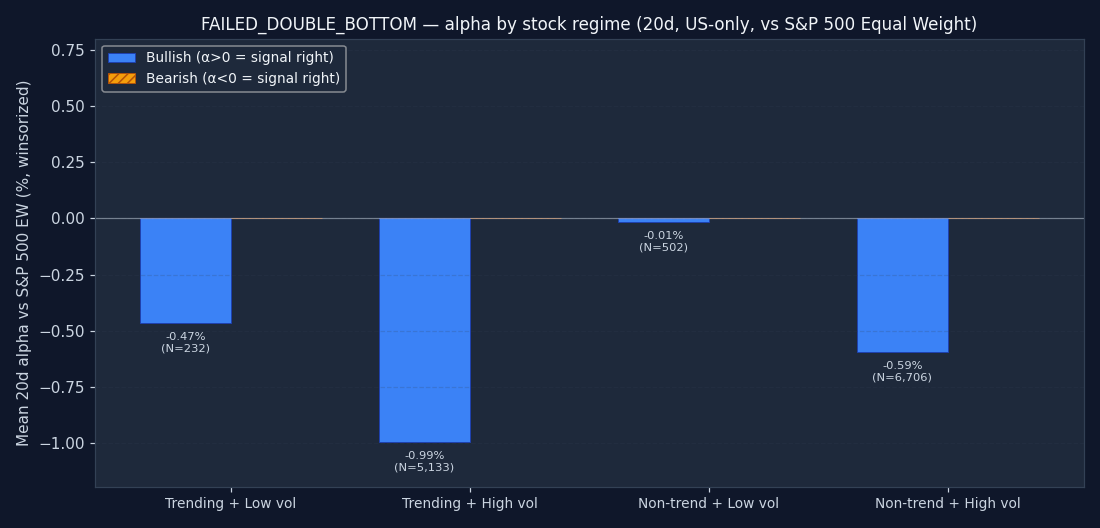
Each trigger is tagged with the host stock's own technical regime on the trigger date: is the stock itself in a trend (ADX(14) ≥ 25) or ranging? And is its realized 20-day volatility high (≥ 20% annualized) or low? This is the textbook conditioning variable — "does this signal work better in trending stocks?" — answered at the level of the individual stock, not the market. Positive bars are good for the signal; negative bars mean alpha vanishes into the benchmark or worse.
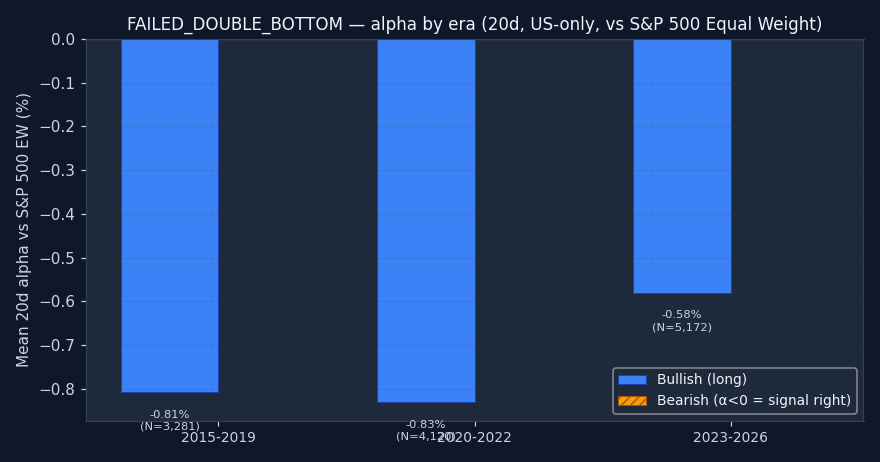
Sub-period check — does the signal work in every era?
A multi-year average can hide major instability. We split the sample into three non-overlapping windows: 2015–2019 (pre-COVID, normalized monetary policy), 2020–2022 (pandemic crash + recovery + rate-shock bear), and 2023+ (post-ZIRP, AI megacap rally). If a signal's alpha is positive overall but comes entirely from one era, that's a red flag — the conditions that produced it may not repeat. A robust signal shows a consistent sign across all non-empty buckets.
↑ Bullish triggers
| Bench | Metric | 1d | 5d | 20d | 60d | 252d |
|---|---|---|---|---|---|---|
| spx | Stock % | -0.12% | -0.26% | +0.41% | +2.05% | +11.59% |
| Bench % | -0.03% | +0.15% | +1.34% | +3.79% | +15.04% | |
| Alpha % | -0.08% | -0.41% | -0.89% | -1.72% | -3.46% | |
| Median alpha | -0.06% | -0.45% | -1.16% | -3.09% | -11.85% | |
| Hit rate (α>0) | 48.5% | 45.9% | 44.7% | 42.0% | 37.3% | |
| p (naive) | 0.0030 | <0.001 | <0.001 | <0.001 | <0.001 | |
| p (HAC) | 0.0031 | <0.001 | <0.001 | <0.001 | 0.0051 | |
| N | 12,567 | 12,500 | 12,315 | 12,116 | 10,987 | |
| msci | Stock % | -0.12% | -0.26% | +0.41% | +2.05% | +11.59% |
| Bench % | +-0.00% | +0.13% | +1.18% | +3.30% | +13.00% | |
| Alpha % | -0.11% | -0.42% | -0.74% | -1.23% | -1.58% | |
| Median alpha | -0.15% | -0.49% | -1.07% | -2.57% | -9.57% | |
| Hit rate (α>0) | 46.9% | 45.4% | 45.0% | 43.4% | 39.1% | |
| p (naive) | <0.001 | <0.001 | <0.001 | <0.001 | 0.0025 | |
| p (HAC) | <0.001 | <0.001 | <0.001 | <0.001 | 0.1986 | |
| N | 12,488 | 12,397 | 12,242 | 12,056 | 10,914 | |
| spxew | Stock % | -0.12% | -0.26% | +0.41% | +2.05% | +11.59% |
| Bench % | -0.10% | +-0.00% | +1.15% | +3.09% | +11.54% | |
| Alpha % | -0.04% | -0.28% | -0.73% | -1.03% | +0.13% | |
| Median alpha | -0.06% | -0.34% | -0.99% | -2.46% | -8.20% | |
| Hit rate (α>0) | 48.6% | 46.5% | 45.1% | 43.2% | 40.6% | |
| p (naive) | 0.1566 | <0.001 | <0.001 | <0.001 | 0.7979 | |
| p (HAC) | 0.1592 | <0.001 | <0.001 | <0.001 | 0.9105 | |
| N | 12,498 | 12,381 | 12,164 | 11,936 | 10,884 |
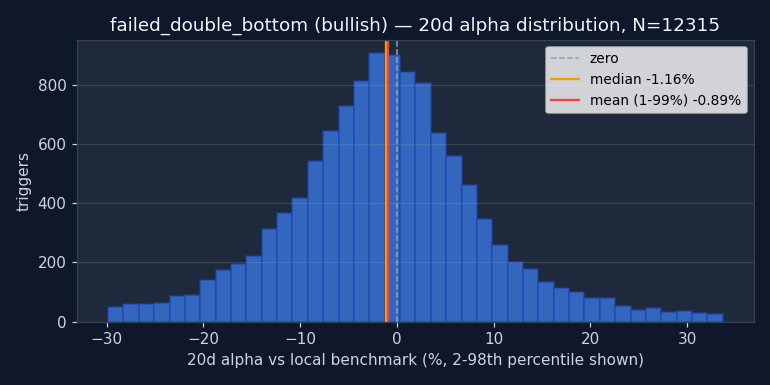
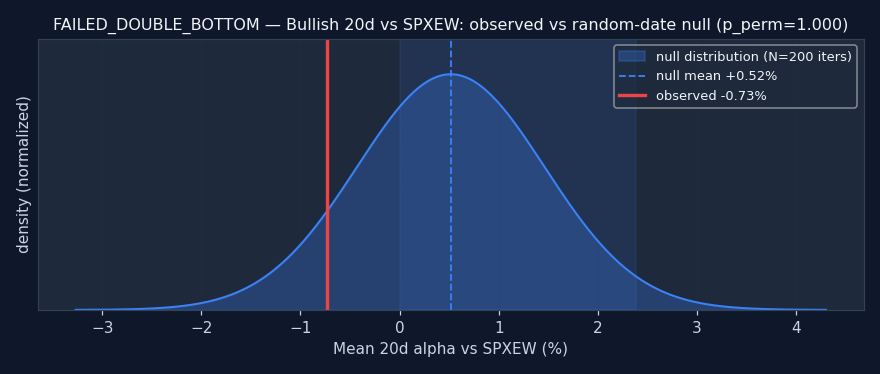
Permutation null detail — all horizons × both benchmarks
| Horizon | Bench | Observed α | Null mean | Null 95% CI | pperm |
|---|---|---|---|---|---|
| 1d | spx | -0.08% | +0.02% | [-0.07%, +0.07%] | 0.995 |
| 1d | msci | -0.11% | -0.00% | [-0.10%, +0.04%] | 0.995 |
| 1d | spxew | -0.04% | -0.00% | [-0.10%, +0.04%] | 0.478 |
| 5d | spx | -0.41% | +0.11% | [-0.13%, +0.82%] | 1.000 |
| 5d | msci | -0.42% | +0.12% | [-0.12%, +0.82%] | 1.000 |
| 5d | spxew | -0.28% | +0.14% | [-0.10%, +0.85%] | 1.000 |
| 20d | spx | -0.89% | +0.33% | [-0.17%, +2.20%] | 1.000 |
| 20d | msci | -0.74% | +0.45% | [-0.05%, +2.32%] | 1.000 |
| 20d | spxew | -0.73% | +0.52% | [+0.00%, +2.38%] | 1.000 |
| 60d | spx | -1.72% | +0.45% | [-0.31%, +1.56%] | 1.000 |
| 60d | msci | -1.23% | +0.91% | [+0.10%, +2.13%] | 1.000 |
| 60d | spxew | -1.03% | +1.12% | [+0.32%, +2.25%] | 1.000 |
| 252d | spx | -3.46% | +0.34% | [-1.58%, +2.74%] | 1.000 |
| 252d | msci | -1.58% | +2.66% | [+0.79%, +5.09%] | 1.000 |
| 252d | spxew | +0.13% | +3.99% | [+2.08%, +6.42%] | 1.000 |
Example triggers on US large-caps (2023+, mcap ≥ $30B)
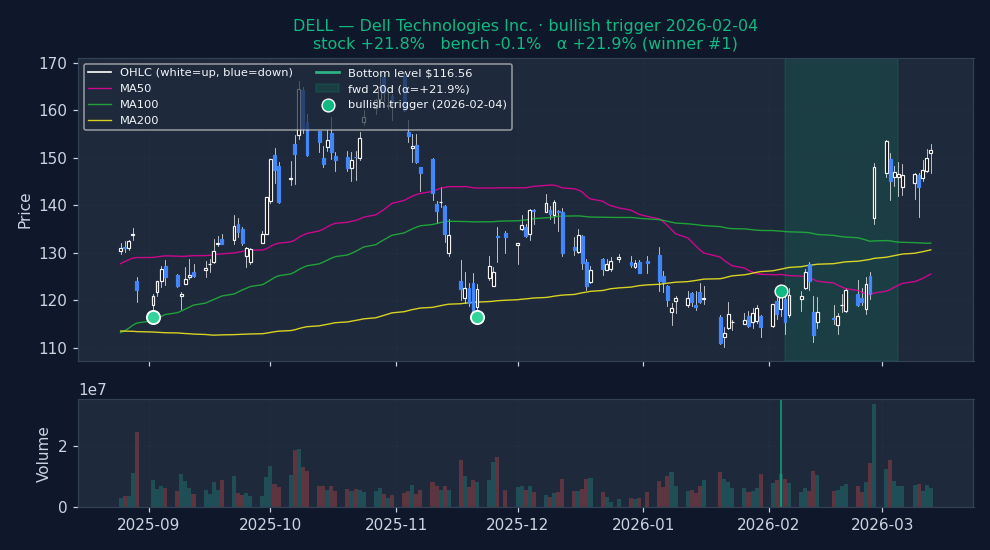
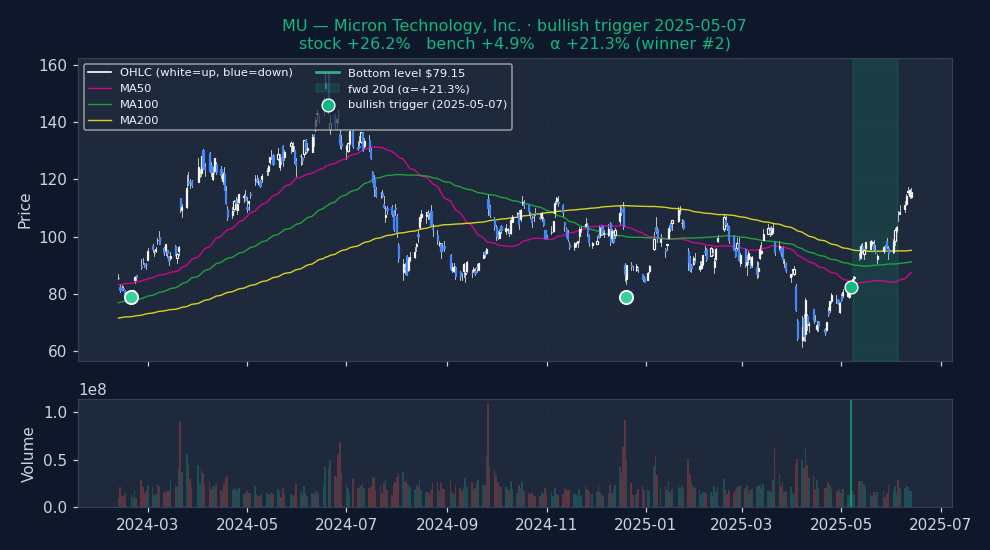
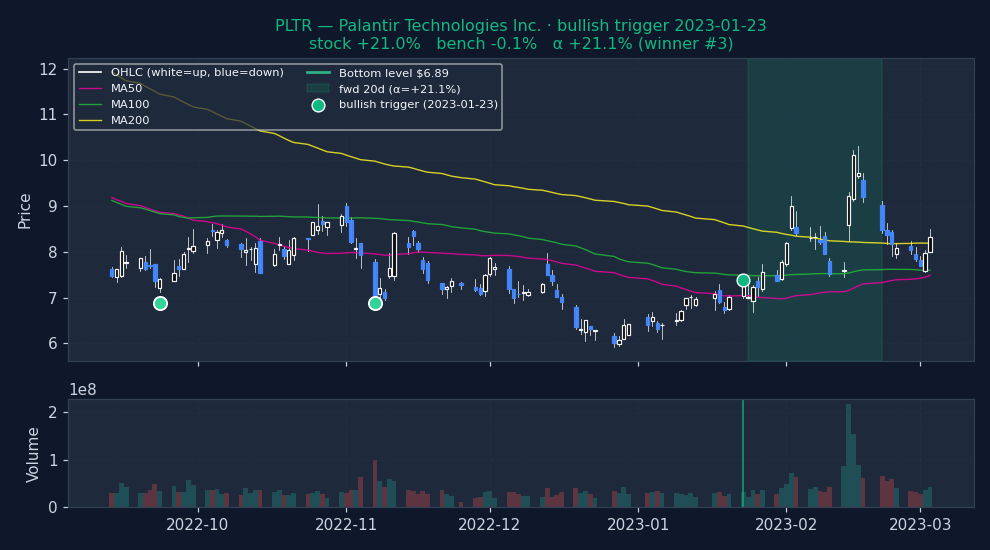
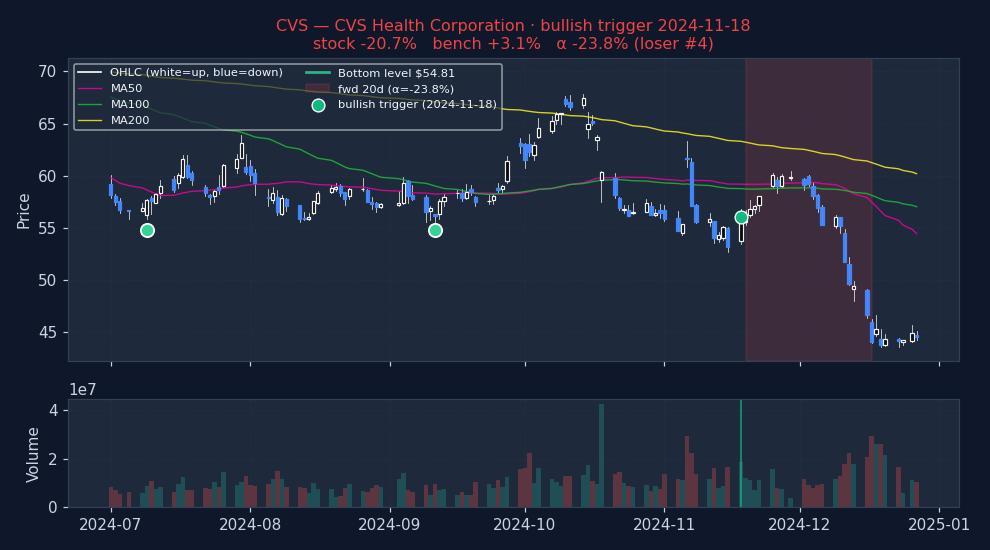
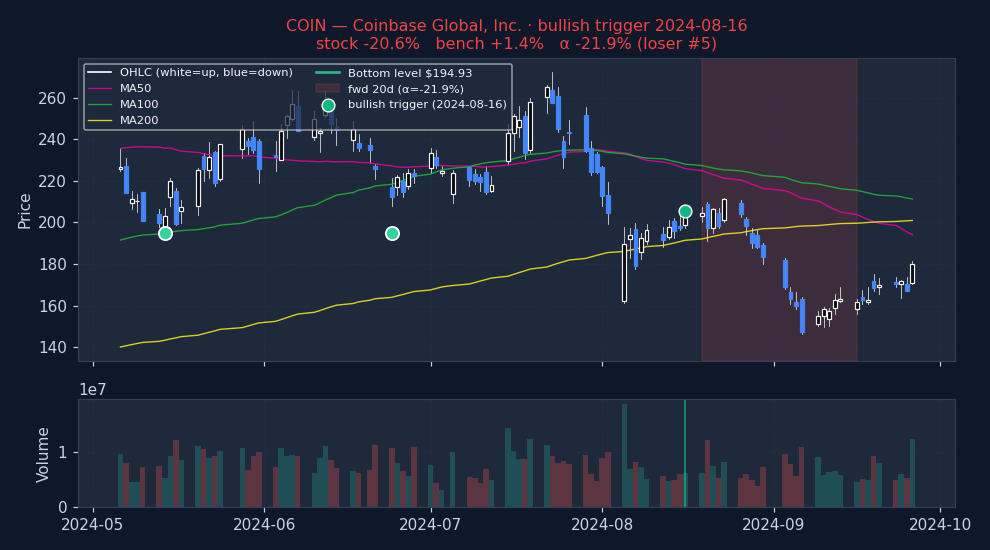
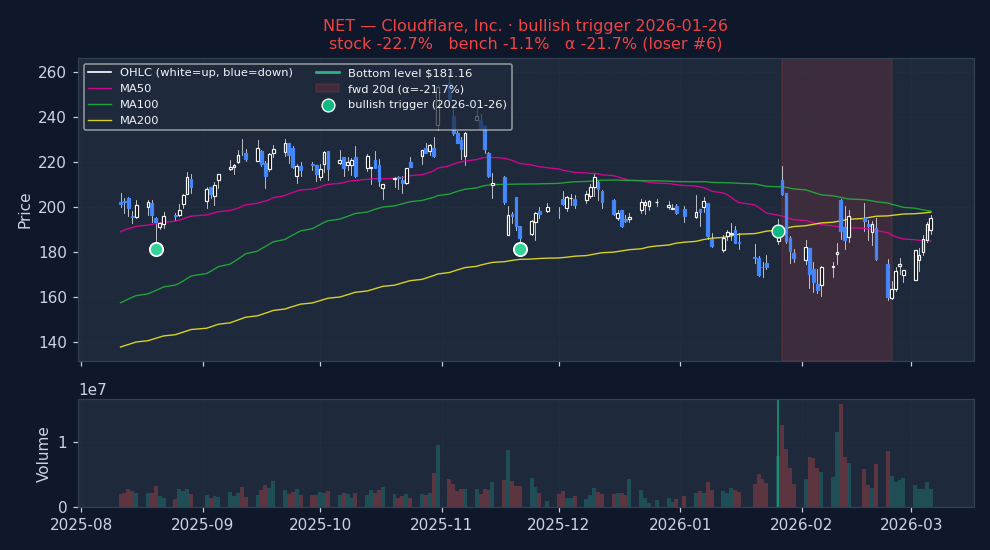
Six recent bullish FAILED_DOUBLE_BOTTOM triggers on US mega-caps, filtered to |alpha| ≤ 25% to exclude catalyst-driven outliers (earnings surprises, M&A, binary events). The first three are the strongest outcomes — what the signal looks like when it works. The last three are the weakest — what the signal looks like when it fails. Each chart shows the stock's price with signal-appropriate technical overlays (e.g. MACD subpanel on MACD pages, Bollinger Bands on Bollinger pages, the 52-week trailing max line on 52w-high pages), a dot marking the trigger date, and the forward window shaded (green when the signal was right, red when it wasn't). Click any chart to open full-size.
Strongest outcomes (what FAILED_DOUBLE_BOTTOM looks like when it works)
Weakest outcomes (what FAILED_DOUBLE_BOTTOM looks like when it fails)
Stock-regime quadrants (2×2 per-stock, 20d alpha detail table)
| Quadrant | N | Stock % (spx) | Bench % (spx) | Alpha % (spx) | p (HAC) | Stock % (msci) | Bench % (msci) | Alpha % (msci) | p (HAC) | Stock % (spxew) | Bench % (spxew) | Alpha % (spxew) | p (HAC) |
|---|---|---|---|---|---|---|---|---|---|---|---|---|---|
| Trending + Low vol Clean directional grind, low whipsaw | 232 | -0.58% | +0.34% | -0.84% | 0.0620 | -0.58% | +0.28% | -0.78% | 0.0759 | -0.58% | -0.09% | -0.47% | 0.2872 |
| Trending + High vol Crisis selloff or parabolic rally | 5,133 | +0.40% | +1.63% | -1.21% | <0.001 | +0.40% | +1.33% | -0.93% | <0.001 | +0.40% | +1.36% | -0.99% | <0.001 |
| Non-trending + Low vol Quiet chop, summer doldrums | 502 | +0.25% | +0.54% | -0.29% | 0.3379 | +0.25% | +0.39% | -0.11% | 0.6999 | +0.25% | +0.36% | -0.01% | 0.9579 |
| Non-trending + High vol Classical "whipsaw zone" for momentum | 6,706 | +0.48% | +1.20% | -0.70% | <0.001 | +0.48% | +1.17% | -0.65% | <0.001 | +0.48% | +1.09% | -0.59% | 0.0002 |
Sub-period breakdown table (20d alpha)
| Period | N | Alpha % (spx) | p (HAC) | Alpha % (msci) | p (HAC) | Alpha % (spxew) | p (HAC) |
|---|---|---|---|---|---|---|---|
| 2015-2019 2015-01-01 → 2020-01-01 | 3,281 | -0.73% | <0.001 | -0.54% | 0.0032 | -0.81% | <0.001 |
| 2020-2022 2020-01-01 → 2023-01-01 | 4,120 | -0.95% | <0.001 | -0.63% | 0.0086 | -0.83% | 0.0004 |
| 2023-2026 2023-01-01 → 2099-01-01 | 5,172 | -0.94% | <0.001 | -0.99% | <0.001 | -0.58% | 0.0031 |
Methodology and caveats
How to read. Entry at open of T+1 (one trading day after the signal fires on close of T). 20d = open T+1 to close T+20. Alpha = stock return − benchmark return over the same window (Convention A, single-sided, textbook). For bullish triggers, POSITIVE alpha = signal was right. For bearish triggers, NEGATIVE alpha = signal was right (stock underperformed market). No sign-flipping; the direction of the bet determines what "good" looks like. Per-stock regime is each stock's own ADX(14) and RV(20) at the trigger date — not market-wide state.
Three p-values, three robustness tests. (a) p_naive: scipy one-sample t-test on winsorized alphas. Optimistic because overlapping 20d windows on the same ticker inflate effective N. (b) p_hac: Newey-West HAC with lag = horizon — corrects for the overlap and is the academic-finance standard. (c) p_perm: fraction of 200 random-date null iterations with mean ≥ observed. Tests whether the signal beats random date selection at all. A signal that clears all three (pnaive, phac, pperm all < 0.05) has real information; a signal that fails pperm has zero edge even if the t-test says "significant."
Caveats. (i) Universe reflects today's active tickers; delisted losers pruned → survivorship bias. (ii) Mcap ≥ $100M filter uses today's snapshot, not point-in-time — mild lookahead on which stocks enter the sample, not on returns. (iii) Means and p-values use winsorized alphas (1/99 percentile) to prevent data errors from dominating. Medians and hit rates use raw data. (iv) Zero transaction costs assumed. Realistic bid-ask + commissions remove 20–40bps from 20d alpha on US large-caps, more on small-cap. Sub-20bps alpha is noise in practice. (v) Past performance does not predict future results.
How to use this
1 · When to reach for this signal
Caution recommended. Bullish 20d alpha is -0.89% and worse than random — triggering on random dates would have produced better long-side returns. Either direction fails the "beats random" test. Don't use Failed Double Bottom Breakdown as a standalone entry trigger. It may still be useful as part of a composite (section 4).
2 · When it works — the setups that drive it
- Best bullish setup: Non-trending + Low vol — alpha -0.29% / 20d on 502 historical triggers.
- Best era for bullish: 2015-2019 — alpha -0.73% / 20d.
3 · When it fails — common false positives
- Weakest bullish cell: Trending + High vol — alpha -1.21% / 20d on 5,133 triggers.
- Worst era for bullish: 2020-2022 — alpha -0.95% / 20d.
Signal-specific failure patterns
4 · Pairing inside a screen
The statements below describe how this signal relates to others by construction — which indicator family it belongs to, and where same-family redundancy might reduce the independence of evidence inside a Daily Report. These are taxonomic classifications drawn from standard technical-analysis texts; they are not pairing backtests. A multi-signal convergence backtest is planned but not yet run.
Sequential with completed pattern
Failed-double-bottom and double-bottom-breakdown fire on the same underlying pattern at different points: the breakdown signal fires when price breaks the neckline; failed_double_bottom fires when the pattern fails to complete and price reverses (Edwards & Magee, Technical Analysis of Stock Trends, 11th ed. 2018; Bulkowski, Encyclopedia of Chart Patterns, 3rd ed. 2021). They are sequential rather than concurrent — one signal replacing the other as the setup evolves, not two independent pieces of evidence.
What would likely rescue this signal
This block calls out the data or conditions that could turn a technically weak signal into a usable one in a composite screen. Based on signal mechanics and the observed failure patterns above; individual combinations are not yet backtested.
- Require fundamental anchor — A failed-double-bottom WITH positive EPS revision in the last 30 days is a structurally different bet than a technical-only pattern completion. Commercial fundamentals dep.
- Short-horizon only — If any edge exists, it's at 1-5d when the squeeze is immediate. 20d+ gives the squeeze time to fade and the underlying weakness to reassert. 1d α=−0.08% vs SPX (−0.04% vs SPXEW) — small but still negative, meaning the squeeze bounce has already faded by end of T+1 rather than continuing.
- Use as the failure confirmation of another pattern — The signal's best use may be diagnostic: 'what does a failed bullish-reversal pattern look like' — keep it in docs for educational value rather than as an entry trigger.
See also Why technical-only signals don't survive on their own for the broader argument.
5 · Before you act — a 5-point checklist
- Normal trading day? Rule out earnings (within ±3 days), ex-dividend, or known corporate-action dates — the signal is almost certainly reading noise, not momentum, in those windows.
- Where is price vs its own 50 / 200 DMA? Pattern signals carry their own structural context; check that the implied support/resistance levels have historical relevance, not just the most-recent 3-month range.
- What's the sector breadth doing? An isolated signal in a broadly down-trending sector is a lower-confidence setup than one firing with the rest of its peer group.
- Is ADV20 enough for your size? If the trigger is on a $500M name and you want to move $1M notional, you're the tape. Consider adv20d ≥ 5% of your intended position.
- What invalidates you? Define a price level (for longs: a close below the trigger-day low; for shorts: close above the trigger-day high) and honor it. The backtest alpha is an average; any one trade can be at either tail.
Execution notes
Skip as a trade entry. Consistent negative alpha across every sub-period and every horizon. The pattern's textbook story doesn't survive the data. Useful ONLY as a documentation example of 'why not every classical pattern works on US large-caps'. Entry open T+1 if traded.